
How SEP ERP Works in Real Schools
A Simple, Structured, Guided Implementation Model
SEP ERP is not deployed as a data-entry software. It is implemented as a guided institutional framework. Our process ensures that schools transition step-by-step into structured management without overwhelming leadership or staff.
From initial institutional mapping to structured monitoring and proactive follow-up, the system is introduced gradually, ensuring clarity, role alignment, and smooth adoption across departments.
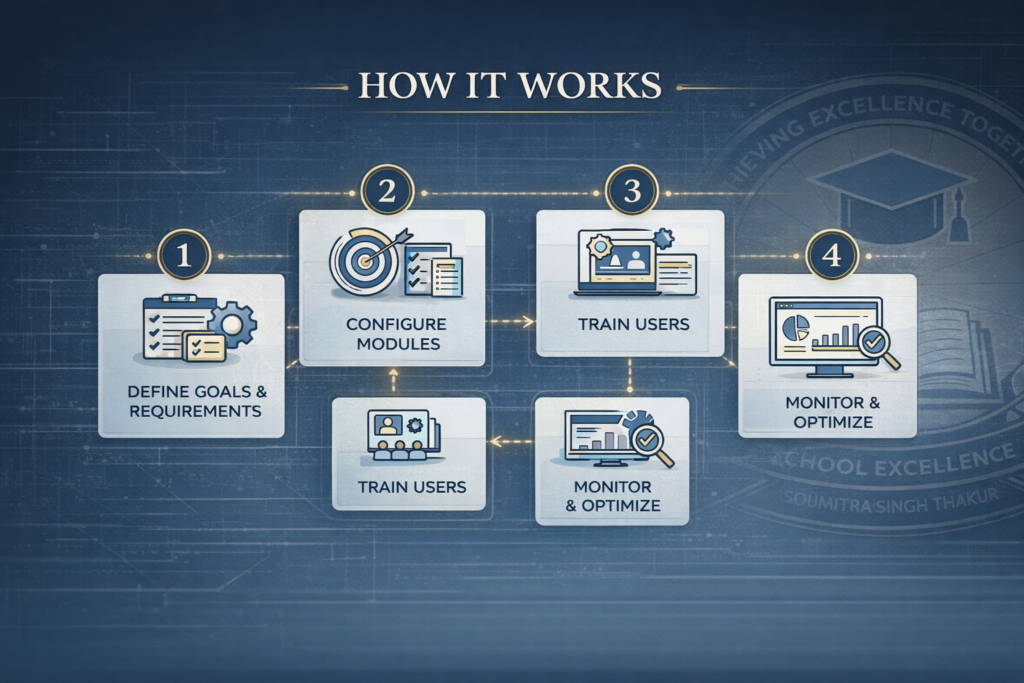
Our 5-Step Guided Implementation Journey
Step 1: Institutional Mapping
- We understand your school structure — classes, departments, academic processes, administrative roles, and operational flow — to align the ERP framework accordingly.
Step 2: Structured System Setup
- Modules are activated in a phased manner. Academic, administrative, examination, and operational areas are aligned without disrupting daily school functioning.
Step 3: Guided Staff Onboarding
- Teachers and staff receive structured guidance to ensure they understand what to update, when to update, and how the system supports their work — not complicates it.
Step 4: Proactive Monitoring & Intelligent Reminders
- Unlike conventional ERPs where schools must identify problems and reach support teams, SEP ERP monitors operational activities internally. If attendance is not marked on time, lesson logs are pending, or required entries are incomplete, the system automatically triggers structured reminders through notifications, WhatsApp, and email to ensure timely compliance.
Step 5: Continuous Leadership Visibility
- School leaders receive structured visibility across departments, enabling them to monitor performance, compliance, and operational flow without manual follow-up.
SEP ERP does not wait for problems to surface. It is designed to identify operational gaps early and guide corrective action proactively.
How It Works:
SEP ERP implementation is designed to be gradual, structured, and supported. Schools are never left to manage complexity alone. The system guides execution, monitors compliance, and supports leadership with clarity — ensuring that operational discipline becomes part of daily functioning.
Implementation Support: Unlike conventional ERP systems where support is reactive, SEP ERP integrates proactive monitoring mechanisms to ensure that essential academic and operational tasks are completed on time.