
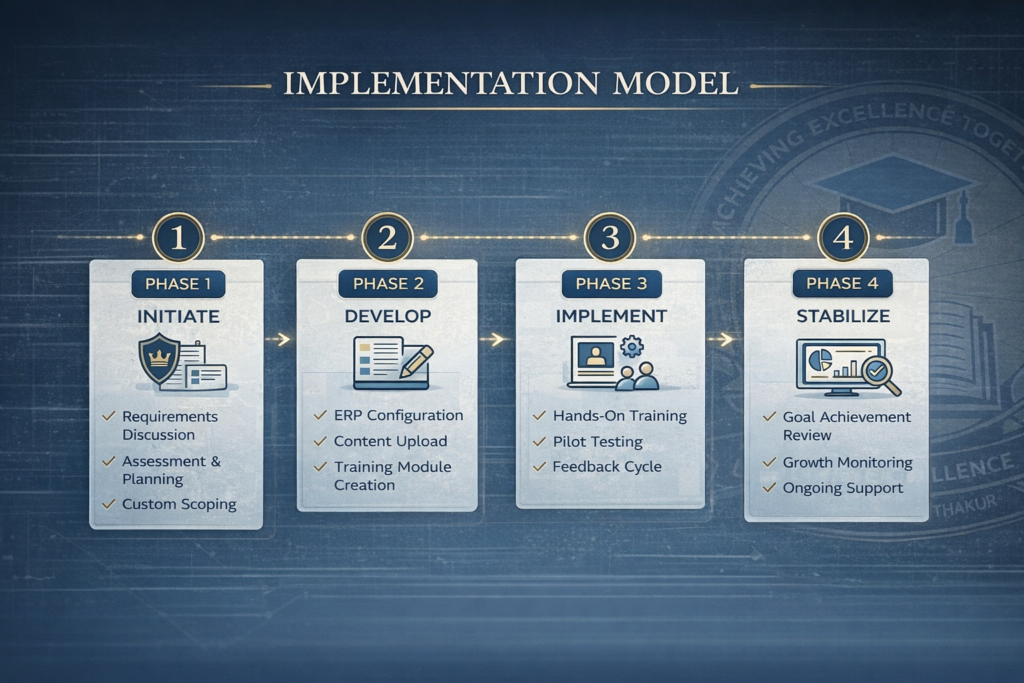
Institutional Deployment Framework
Structured Rollout Designed for Growing Schools
SEP ERP is implemented through a phased institutional deployment model designed to ensure minimal disruption and maximum operational alignment. Rather than introducing sudden systemic change, the framework gradually integrates structured processes into existing school workflows.
Each phase of deployment focuses on alignment, clarity of roles, data discipline, and leadership visibility — ensuring that the system becomes part of daily institutional functioning rather than an external requirement.
Four-Phase Institutional Rollout Model
Phase 1: Institutional Assessment & Alignment
- We begin by understanding your school’s academic structure, administrative flow, departmental roles, and reporting hierarchy. This ensures that system deployment reflects institutional reality rather than forcing artificial structure.
Phase 2: Structured Activation & Role Mapping
- Core modules are activated in a phased manner. Responsibilities are mapped clearly across leadership, administrative, and academic teams to ensure accountability and clarity of execution.
Phase 3: Operational Stabilization
- During the stabilization phase, structured monitoring ensures that academic logs, attendance, compliance entries, and operational updates are aligned with institutional timelines. Support guidance is provided to ensure consistency.
Phase 4: Continuous Governance Monitoring
- Post-deployment, SEP ERP transitions into a governance-support framework — offering leadership visibility, proactive compliance reminders, and structured performance monitoring to maintain operational discipline.
Why Choose The School Blueprint?
- SEP ERP deployment is not a one-time installation. It is a structured institutional transition supported through alignment, monitoring, and continuous guidance. Schools are gradually integrated into system-driven governance without operational disruption.
How It Works:
- The objective of the implementation model is to ensure long-term operational discipline, leadership visibility, and academic consistency across departments.
Unlike conventional ERP systems that operate reactively, SEP ERP integrates proactive governance mechanisms to ensure that academic and operational processes remain aligned with institutional timelines.